Support at Home, made simple — with a team you come to know

Getting started with aged care support can feel like a lot — forms, assessments, funding, waiting. Here’s how it works, in plain language, and exactly where we come in to help.
You don’t need your funding sorted before you call us. Talk to us at any point — before your assessment, while you’re waiting, or once your funding comes through. There’s no cost and no obligation.
Three simple phases, and we’re with you through them
Support at Home has an official process with a number of steps. The good news: you don’t need to memorise it, and the steps often happen alongside each other rather than one neat line. We’ll help you make sense of where you are and what happens next. It comes down to three simple phases.

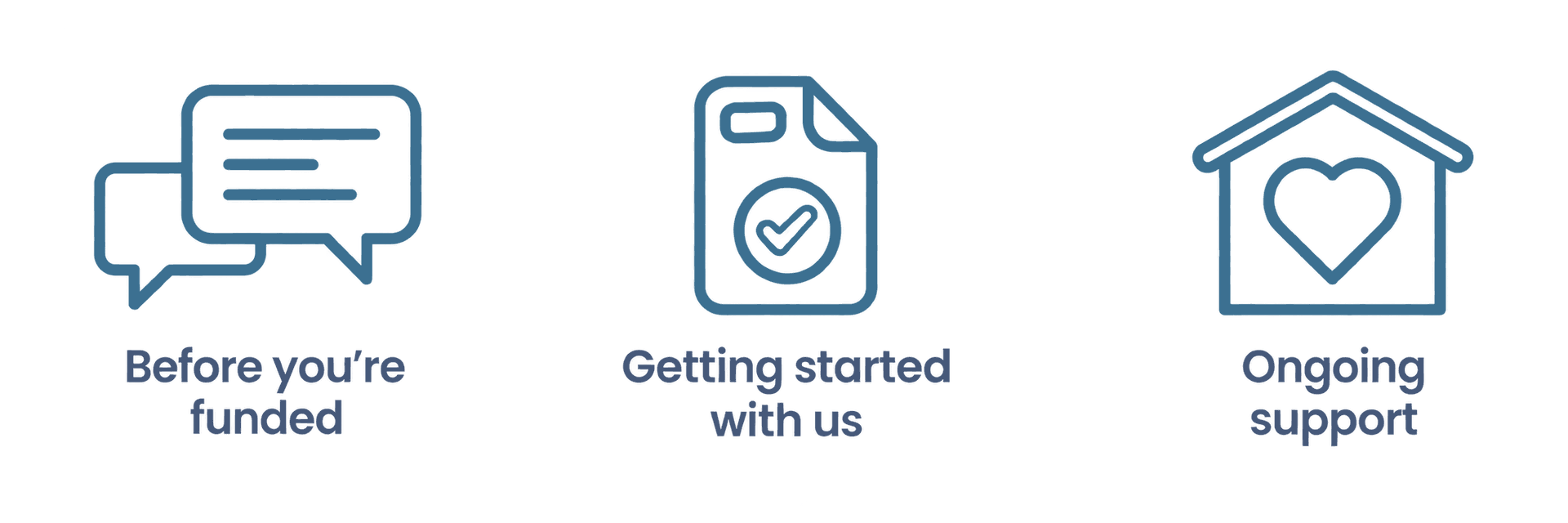
Before you’re funded
Getting assessed and approved for funding. This part runs through My Aged Care — and you can lean on us from the very start to understand it.
Getting started with us
Your funding comes through, you choose us, and together we set up your support the way you want it.
Ongoing support
The day-to-day. A consistent team who know you, a care partner in your corner, and support that keeps up as things change.
Want the official version? See the Government’s Support at Home steps
- Register / request assessment with My Aged Care
- Assessment
- Approval and funding decision
- Funding becomes available (by priority)
- Choose a provider and sign an agreement (within 56 days)
- Start and review support
Before you’re funded
This part happens with My Aged Care and Services Australia. Here’s what to expect, and how we help even before you’re a client.
Apply for an assessment
Everything starts with a free aged care assessment, arranged through My Aged Care. You can request one yourself, or your GP or hospital can help.
Apply for an assessment
Everything starts with a free aged care assessment, arranged through My Aged Care. You can request one yourself, or your GP or hospital can help.
Have your assessment
An assessor visits, usually at home,
and works out what support would help. You can have family with you.
Have your assessment
An assessor visits, usually at home, and works out what support would help. You can have family with you.
Get your funding decision
You’ll get a letter telling you what
you’ve been approved for. Sometimes there’s a wait before funding becomes
available — we’ll tell you straight what to expect.
Get your funding decision
You’ll get a letter telling you what you’ve been approved for. Sometimes there’s a wait before funding becomes available — we’ll tell you straight what to expect.
Getting started with us
Once your funding comes through, this is where we step in properly. No jargon, no run-around — we set things up with you, at your pace.
Choose us and set things up
When your funding is ready, you choose
your provider. Pick us, and we’ll sit down with you and set everything up
together.
Choose us and set things up
When your funding is ready, you choose your provider. Pick us, and we’ll sit down with you and set everything up together.
We build your support around you
We agree what support looks like,
who’ll be coming, and when — and we put it in writing so there are no
surprises.
We build your support around you
We agree what support looks like, who’ll be coming, and when — and we put it in writing so there are no surprises.
What ongoing support feels like
Ongoing support is the day to day — a consistent team who know you, a care partner coordinating your support, and care that adjusts as life changes.
You’re looked after by people who know you
We work hard to send the same familiar faces, so the people in your home already know how you like things done.
If something changes, tell us once
Tell the support worker in your home, and it reaches your care partner. Your care partner is a real person who knows your situation and is your point of contact when you need one.
The people in your home are trained for real life
Our support workers are trained to support people living with dementia, help with medication, and stay calm and steady when things get difficult — what is often called de-escalation. New workers learn on the job with experienced staff alongside them before they support you on their own.
Support that keeps up as life changes
Needs change — a fall, a hospital stay, a partner’s health, a harder stretch with dementia. You don’t have to wait for a scheduled review to get help. Tell us what’s changed and we’ll work with you to adjust your support. When it helps, we’ll coordinate with your GP, hospital, specialists and other services so you’re not the one holding it all together.
Someone keeps an eye on the bigger picture
Your care partner stays in regular contact and reviews how things are going, so support is adjusted before small things become big ones. At least once a year we step back with you and look at whether your support is still right — and if your needs have grown, we help you ask for a reassessment.
(If you remember the old Home Care Package days, a care partner is what you might have called a care manager.)
Referring a patient or client?
This page is written for older people and their families. If you’re a discharge planner, GP, assessor or community clinician, our For Referrers page has what you need — our capability statement, referral form, response times and direct line to our clinical lead.
Go to For Referrers →Where to next
Worried about a parent or partner
Memory changes, more falls, not coping like before? Start here — you don’t need a diagnosis to ask for help. Start here →Getting someone home from hospital
Is someone in hospital now, and you’re worried about how they’ll cope at home? There’s short-term support designed to help them recover safely at home — and it’s best set up before they’re discharged. Here’s how it works. Start here →Support for you, the carer
Looking after someone is hard. There’s help for you too, not just the person you care for. Start here →What will it cost me?
See how Support at Home costs work and what your contribution might look like — in plain numbers. Start here →Frequently asked questions
Money & cost
What will Support at Home actually cost me?
What is the 10% care management fee?
What does “no worse off” mean for me?
Who decides how much funding I get?
Waiting & funding
How long does it take to get Support at Home funding?
I’ve been approved — so why am I not funded yet?
What happens if Mum gets worse while we’re waiting?
Can I talk to a provider before my funding is approved?
Getting started & choosing
How do I choose a good Support at Home provider?
What happens if I miss the 56-day deadline after my funding letter?
Can I change provider if it’s not working out?
Living with support
What is a care partner?

Start the conversation
Wherever you are — not started, still waiting, or ready to go — we can help. Leave your details and we’ll call you back.
We answer enquiries by the next business day.
Start the conversation
Leave your details — we will call you back.