Dementia care at home, from the first changes to the hardest days

Dementia support at home across South East Queensland, led by a Registered Nurse — with behaviour support plans and de-escalation-trained support workers we employ directly.
You don’t need a diagnosis, or your funding sorted, to talk to us.
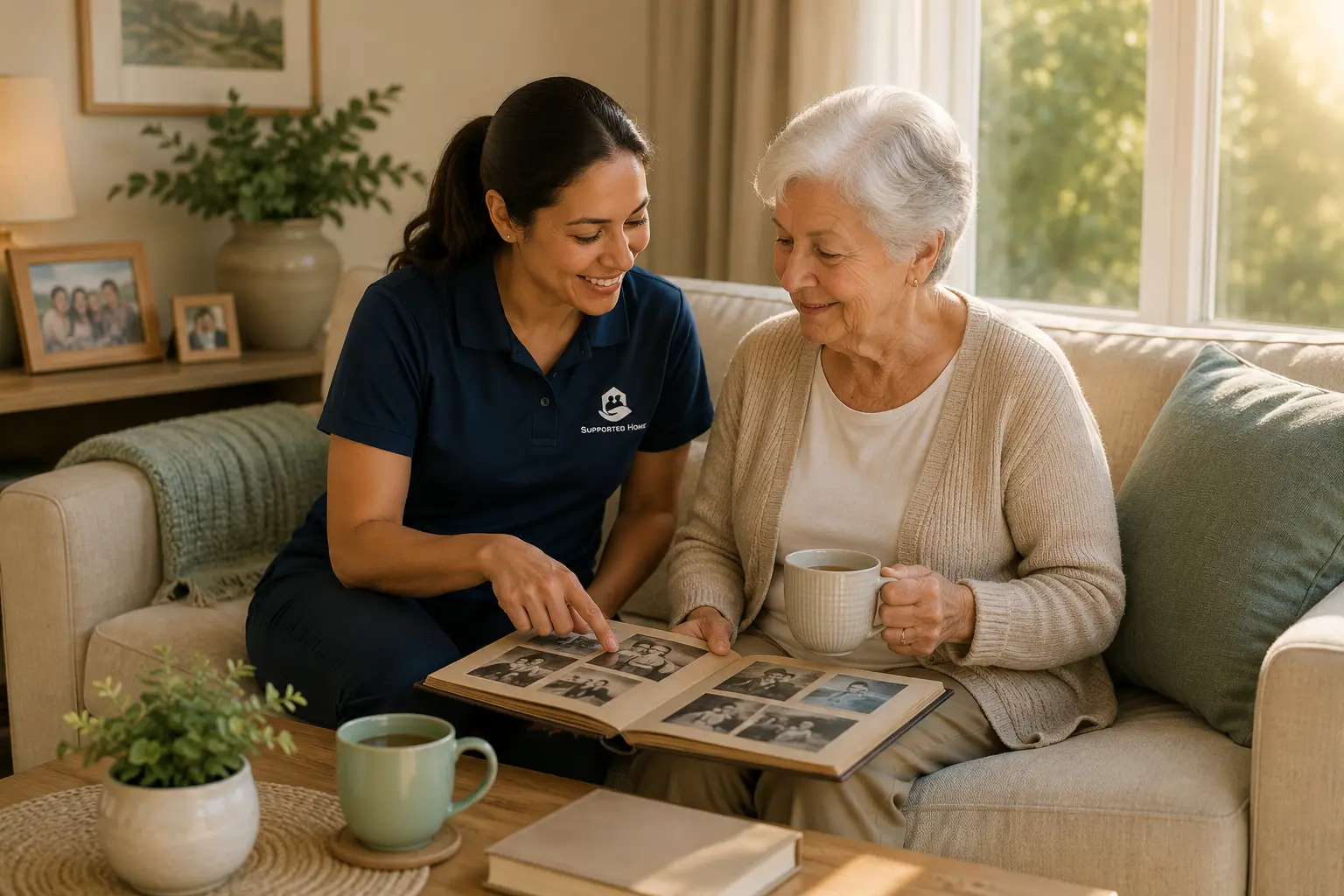


We support people through the changed behaviours and distress of dementia — sometimes called BPSD — from the first changes onward.
We cover greater Brisbane, Moreton Bay, Logan, the Sunshine Coast and the Gold Coast.
Support that meets you where you are
From the first changes to the most complex days, there is a place to start.
The first changes
Repeated questions. Missed medication. Getting lost on a familiar drive, or a personality that seems to be shifting. When something is not quite right, it can be hard to know whether to worry. These can be early signs of dementia, and noticing them early helps. We help you make sense of what you are seeing, and put gentle support in place at whatever pace suits your family.
Everyday support that keeps life steady
Familiar faces and a consistent routine. Help with the day too, from personal care and meals to medication prompts and getting out of the house. We send the same small team, so the face at the door is one the person knows. That consistency matters most when memory does not hold.
The harder days (behaviour and distress)
Agitation, distress, wandering, resistance to care, changes that frighten the people who love them. These are the behaviours and distress that can come with dementia, sometimes called BPSD. This is exactly what our dementia care is built for.
Our workers are trained in de-escalation — to read what a behaviour is telling us and respond calmly before a situation escalates. Each person has a behaviour plan written with our Registered Nurse and reviewed as things change. When a day goes beyond the plan, there is a clear escalation pathway to our clinical team. When our workers are with you, they are backed by our on-call arrangements, so that there is continuity when something changes. We work alongside your GP, geriatrician or mental health team.
If today is one of the hard days, call our care team on (07) 3517 0808.
A team that knows dementia
Dementia care takes real skill. The people who do it well are kind as well as capable. Our care workers are directly employed by Supported Home, so we train them, know them, and send the same familiar faces. They complete specialist dementia training, delivered in-house, and work to a model of care led by our Registered Nurse and Clinical Lead.
Support for the family, too
Caring for someone with dementia is relentless. We build in respite so you can rest, sleep, work, or simply step away. We keep you informed about what is happening and what comes next.
If you just need a break, that’s reason enough to call. →How our dementia care works
Led by a Registered Nurse
Wanessa Arraes, our Clinical Lead, is a Registered Nurse. Every dementia care plan is built and reviewed clinically, and kept current as needs change.
A plan for behaviour, before it is a crisis
We assess what drives a person’s distress and write a behaviour plan around it. Our directly employed workers are trained to follow it and to escalate early. When something changes, the plan changes with it.
Alongside your clinical team
We coordinate with your GP, geriatrician, dementia adviser and mental health team. We add capable, consistent in-home support that sits around the clinical care already in place.
Frequently asked questions
What are the early signs of dementia?
What are the different types of dementia?
Can you support someone whose dementia causes agitation, aggression or distress?
What happens on a really bad day, or in a crisis?
Do I need a dementia diagnosis before you can help?
Will the same care workers come each time?
Are your care workers actually trained in dementia, or just willing?
How does dementia respite work, and can I get a break?
Can you keep supporting us as the dementia progresses?
Related support
Behaviour and mood often sit alongside depression, anxiety or grief in older people.
Mental health and wellbeing →Need a break, or everyday help around the home?
Reliable home care and respite →
Start the conversation
Leave your details — we will call you back.
We answer enquiries by the next business day.